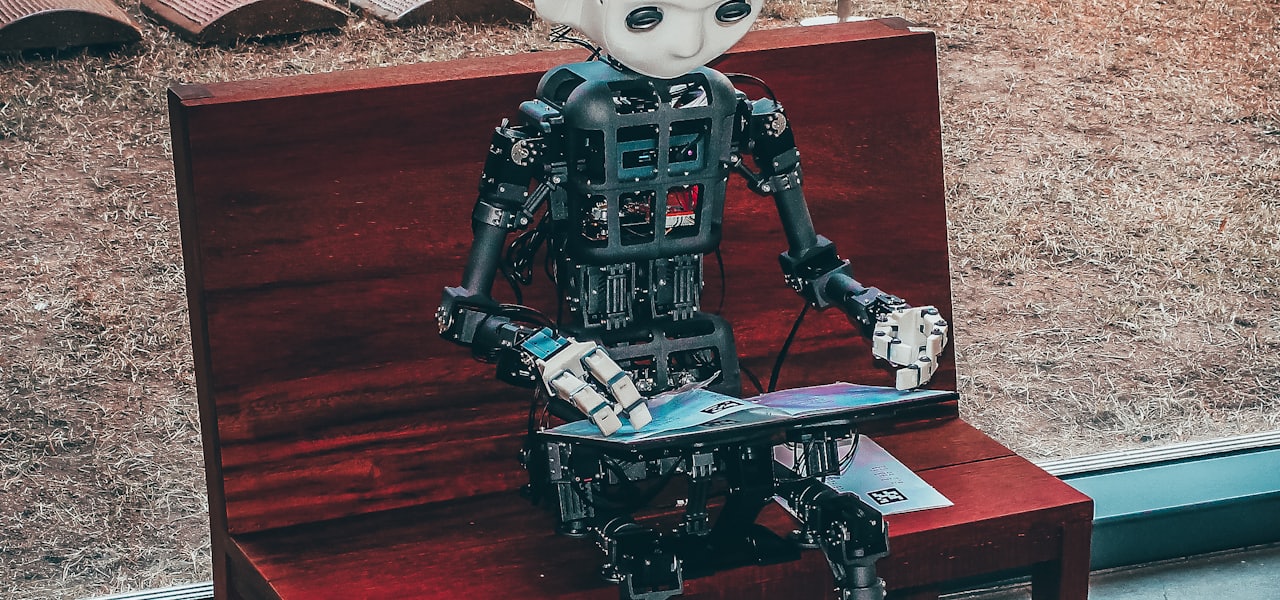
The United States Department of Defense has been analyzing and employing military applications of artificial intelligence since at least 2014. The program initially focused on drones and other robots, but has also been using large language models for military research and analysis. The current US policy on lethal autonomous weapons is Department of Defense Directive 3000.09, updated in January 2023. == Background == The United States Department of Defense began developing lethal autonomous weapons as early as the Reagan administration. An early version of the Tomahawk missile could have been used to destroy Soviet ships without direct human control; the initiative was abandoned after the United States and the Soviet Union signed START I. By 2014, the United Kingdom, Israel, and Norway had already begun using missiles equipped with artificial intelligence systems. The Department of Defense established a policy on the use of artificial intelligence in 2012. == History == === 2016–2017: Carter secretaryship === In May 2016, secretary of defense Ash Carter stated that his Third Offset strategy would include utilizing artificial intelligence as a military advantage. The New York Times reported that year that the Department of Defense had tested an autonomous drone at an approximation of a Middle Eastern village at Camp Edwards. Deputy secretary of defense Robert O. Work, who advocated for developing artificial intelligence, told the Times that the United States needed to compete with China and Russia by having a tactical advantage they could not easily replicate. The initiative was developed by DARPA beginning in 2015. The use of artificial intelligence in the U.S. military was controversial within the department; in February, Paul Scharre, who worked for the Office of the Secretary of Defense in the secretaryships of Robert Gates and Leon Panetta, published a report about the risks of artificial intelligence for broad military applications. === 2017–2019: Mattis secretaryship === By 2017, the United States Air Force had already begun using artificial intelligence in military robots. The Air Force's use of Neurala, an artificial intelligence company, concerned officials in the Department of Defense after an investigation found that Neurala had accepted money from an investment firm with funding from a state-run Chinese company. The Department of Defense began heavily investing in artificial intelligence after Work established Project Maven, an initiative to encourage the development and integration of artificial intelligence in the military, in April 2017. In May 2018, secretary of defense Jim Mattis privately expressed to president Donald Trump that he needed to establish a national strategy on artificial intelligence, quoting an article from former secretary of state Henry Kissinger that called for a presidential commission on the technology. The Department of Defense established the Joint Artificial Intelligence Center the following month. Google began working with the Department of Defense on analyzing drone footage as early as March. Google's involvement in the initiative led to protests from employees and mass resignations. Seeking to quell internal unrest, Google stated it would not renew its contract with the Department of Defense in June. The Department of Defense announced an artificial intelligence contract with Microsoft in October. === 2025–present: Hegseth secretaryship === In December 2025, secretary of defense Pete Hegseth announced GenAI.mil, an artificial intelligence platform for the Department of Defense. In a video announcing the platform, Hegseth stated that Department of Defense workers would be able to "conduct deep research, format documents and even analyze video or imagery." The Department of Defense contracted first Gemini by Google, then ChatGPT by OpenAI, and finally Grok by xAI for the platform. Claude by Anthropic was also contracted by the Department of Defense and was in use on secure servers until it was revealed that Claude had been used in the 2026 operation to capture Nicolás Maduro, who was at the time the leader of Venezuela. This revelation sparked a high-profile dispute over Anthropic's ability to constrain Claude's useage, resulting in the termination of Anthropic's $200 million defense contract. The Department of Defense also moved to label Anthropic a supply chain risk, which was later blocked by a federal judge.
Collateral freedom
Collateral freedom is an anti-censorship strategy that attempts to make it economically prohibitive for censors to block content on the Internet. This is achieved by hosting content on cloud services that are considered by censors to be "too important to block", and then using encryption to prevent censors from identifying requests for censored information that is hosted among other content, forcing censors to either allow access to the censored information or take down entire services.
Model-based clustering
In statistics, cluster analysis is the algorithmic grouping of objects into homogeneous groups based on numerical measurements. Model-based clustering based on a statistical model for the data, usually a mixture model. This has several advantages, including a principled statistical basis for clustering, and ways to choose the number of clusters, to choose the best clustering model, to assess the uncertainty of the clustering, and to identify outliers that do not belong to any group. == Model-based clustering == Suppose that for each of n {\displaystyle n} observations we have data on d {\displaystyle d} variables, denoted by y i = ( y i , 1 , … , y i , d ) {\displaystyle y_{i}=(y_{i,1},\ldots ,y_{i,d})} for observation i {\displaystyle i} . Then model-based clustering expresses the probability density function of y i {\displaystyle y_{i}} as a finite mixture, or weighted average of G {\displaystyle G} component probability density functions: p ( y i ) = ∑ g = 1 G τ g f g ( y i ∣ θ g ) , {\displaystyle p(y_{i})=\sum _{g=1}^{G}\tau _{g}f_{g}(y_{i}\mid \theta _{g}),} where f g {\displaystyle f_{g}} is a probability density function with parameter θ g {\displaystyle \theta _{g}} , τ g {\displaystyle \tau _{g}} is the corresponding mixture probability where ∑ g = 1 G τ g = 1 {\displaystyle \sum _{g=1}^{G}\tau _{g}=1} . Then in its simplest form, model-based clustering views each component of the mixture model as a cluster, estimates the model parameters, and assigns each observation to cluster corresponding to its most likely mixture component. === Gaussian mixture model === The most common model for continuous data is that f g {\displaystyle f_{g}} is a multivariate normal distribution with mean vector μ g {\displaystyle \mu _{g}} and covariance matrix Σ g {\displaystyle \Sigma _{g}} , so that θ g = ( μ g , Σ g ) {\displaystyle \theta _{g}=(\mu _{g},\Sigma _{g})} . This defines a Gaussian mixture model. The parameters of the model, τ g {\displaystyle \tau _{g}} and θ g {\displaystyle \theta _{g}} for g = 1 , … , G {\displaystyle g=1,\ldots ,G} , are typically estimated by maximum likelihood estimation using the expectation-maximization algorithm (EM); see also EM algorithm and GMM model. Bayesian inference is also often used for inference about finite mixture models. The Bayesian approach also allows for the case where the number of components, G {\displaystyle G} , is infinite, using a Dirichlet process prior, yielding a Dirichlet process mixture model for clustering. === Choosing the number of clusters === An advantage of model-based clustering is that it provides statistically principled ways to choose the number of clusters. Each different choice of the number of groups G {\displaystyle G} corresponds to a different mixture model. Then standard statistical model selection criteria such as the Bayesian information criterion (BIC) can be used to choose G {\displaystyle G} . The integrated completed likelihood (ICL) is a different criterion designed to choose the number of clusters rather than the number of mixture components in the model; these will often be different if highly non-Gaussian clusters are present. === Parsimonious Gaussian mixture model === For data with high dimension, d {\displaystyle d} , using a full covariance matrix for each mixture component requires estimation of many parameters, which can result in a loss of precision, generalizabity and interpretability. Thus it is common to use more parsimonious component covariance matrices exploiting their geometric interpretation. Gaussian clusters are ellipsoidal, with their volume, shape and orientation determined by the covariance matrix. Consider the eigendecomposition of a matrix Σ g = λ g D g A g D g T , {\displaystyle \Sigma _{g}=\lambda _{g}D_{g}A_{g}D_{g}^{T},} where D g {\displaystyle D_{g}} is the matrix of eigenvectors of Σ g {\displaystyle \Sigma _{g}} , A g = diag { A 1 , g , … , A d , g } {\displaystyle A_{g}={\mbox{diag}}\{A_{1,g},\ldots ,A_{d,g}\}} is a diagonal matrix whose elements are proportional to the eigenvalues of Σ g {\displaystyle \Sigma _{g}} in descending order, and λ g {\displaystyle \lambda _{g}} is the associated constant of proportionality. Then λ g {\displaystyle \lambda _{g}} controls the volume of the ellipsoid, A g {\displaystyle A_{g}} its shape, and D g {\displaystyle D_{g}} its orientation. Each of the volume, shape and orientation of the clusters can be constrained to be equal (E) or allowed to vary (V); the orientation can also be spherical, with identical eigenvalues (I). This yields 14 possible clustering models, shown in this table: It can be seen that many of these models are more parsimonious, with far fewer parameters than the unconstrained model that has 90 parameters when G = 4 {\displaystyle G=4} and d = 9 {\displaystyle d=9} . Several of these models correspond to well-known heuristic clustering methods. For example, k-means clustering is equivalent to estimation of the EII clustering model using the classification EM algorithm. The Bayesian information criterion (BIC) can be used to choose the best clustering model as well as the number of clusters. It can also be used as the basis for a method to choose the variables in the clustering model, eliminating variables that are not useful for clustering. Different Gaussian model-based clustering methods have been developed with an eye to handling high-dimensional data. These include the pgmm method, which is based on the mixture of factor analyzers model, and the HDclassif method, based on the idea of subspace clustering. The mixture-of-experts framework extends model-based clustering to include covariates. == Example == We illustrate the method with a dateset consisting of three measurements (glucose, insulin, sspg) on 145 subjects for the purpose of diagnosing diabetes and the type of diabetes present. The subjects were clinically classified into three groups: normal, chemical diabetes and overt diabetes, but we use this information only for evaluating clustering methods, not for classifying subjects. The BIC plot shows the BIC values for each combination of the number of clusters, G {\displaystyle G} , and the clustering model from the Table. Each curve corresponds to a different clustering model. The BIC favors 3 groups, which corresponds to the clinical assessment. It also favors the unconstrained covariance model, VVV. This fits the data well, because the normal patients have low values of both sspg and insulin, while the distributions of the chemical and overt diabetes groups are elongated, but in different directions. Thus the volumes, shapes and orientations of the three groups are clearly different, and so the unconstrained model is appropriate, as selected by the model-based clustering method. The classification plot shows the classification of the subjects by model-based clustering. The classification was quite accurate, with a 12% error rate as defined by the clinical classification. Other well-known clustering methods performed worse with higher error rates, such as single-linkage clustering with 46%, average link clustering with 30%, complete-linkage clustering also with 30%, and k-means clustering with 28%. == Outliers in clustering == An outlier in clustering is a data point that does not belong to any of the clusters. One way of modeling outliers in model-based clustering is to include an additional mixture component that is very dispersed, with for example a uniform distribution. Another approach is to replace the multivariate normal densities by t {\displaystyle t} -distributions, with the idea that the long tails of the t {\displaystyle t} -distribution would ensure robustness to outliers. However, this is not breakdown-robust. A third approach is the "tclust" or data trimming approach which excludes observations identified as outliers when estimating the model parameters. == Non-Gaussian clusters and merging == Sometimes one or more clusters deviate strongly from the Gaussian assumption. If a Gaussian mixture is fitted to such data, a strongly non-Gaussian cluster will often be represented by several mixture components rather than a single one. In that case, cluster merging can be used to find a better clustering. A different approach is to use mixtures of complex component densities to represent non-Gaussian clusters. == Non-continuous data == === Categorical data === Clustering multivariate categorical data is most often done using the latent class model. This assumes that the data arise from a finite mixture model, where within each cluster the variables are independent. === Mixed data === These arise when variables are of different types, such as continuous, categorical or ordinal data. A latent class model for mixed data assumes local independence between the variable. The location model relaxes the local independence assumption. The clustMD approach assumes that the observed variables are manifestations of underlying continuous Gaussian latent
Web container
A web container (also known as a servlet container; and compare "webcontainer") is the component of a web server that interacts with Jakarta Servlets. A web container is responsible for managing the lifecycle of servlets, mapping a URL to a particular servlet and ensuring that the URL requester has the correct access-rights. A web container handles requests to servlets, Jakarta Server Pages (JSP) files, and other types of files that include server-side code. The Web container creates servlet instances, loads and unloads servlets, creates and manages request and response objects, and performs other servlet-management tasks. A web container implements the web component contract of the Jakarta EE architecture. This architecture specifies a runtime environment for additional web components, including security, concurrency, lifecycle management, transaction, deployment, and other services. == List of Servlet containers == The following is a list of notable applications which implement the Jakarta Servlet specification from Eclipse Foundation, divided depending on whether they are directly sold or not. === Open source Web containers === Apache Tomcat (formerly Jakarta Tomcat) is an open source web container available under the Apache Software License. Apache Tomcat 6 and above are operable as general application container (prior versions were web containers only) Apache Geronimo is a full Java EE 6 implementation by Apache Software Foundation. Enhydra, from Lutris Technologies. GlassFish from Eclipse Foundation (an application server, but includes a web container). Jetty, from the Eclipse Foundation. Also supports SPDY and WebSocket protocols. Open Liberty, from IBM, is a fully compliant Jakarta EE server Virgo from Eclipse Foundation provides modular, OSGi based web containers implemented using embedded Tomcat and Jetty. Virgo is available under the Eclipse Public License. WildFly (formerly JBoss Application Server) is a full Java EE implementation by Red Hat, division JBoss. === Commercial Web containers === iPlanet Web Server, from Oracle. JBoss Enterprise Application Platform from Red Hat, division JBoss is subscription-based/open-source Jakarta EE-based application server. WebLogic Application Server, from Oracle Corporation (formerly developed by BEA Systems). Orion Application Server, from IronFlare. Resin Pro, from Caucho Technology. IBM WebSphere Application Server. SAP NetWeaver.
Summify
Summify was a social news aggregator founded by Mircea Paşoi and Cristian Strat, two former Google and Microsoft interns from Romania. The service emailed its users a periodic summary of news articles shared from their social networks based on their relevance and importance. The platform supported Twitter, Facebook, and Google Reader accounts. == History == In 2009, Paşoi and Strat created ReadFu, a plugin that provided a contextual summary and statistics of the target page of a hyperlink. In January 2010, ReadFu was accepted into the Vancouver-based start-up incubator Bootup Labs. On March 20, 2010 the service was renamed to Summify and a private beta began. On August 11, 2010 Paşoi and Strat announced a new direction for the service. It would become a real-time social news reader that aggregates incoming news from social networks and displays articles by importance using social reactions. After some feedback that the users preferred article digests by email more than the real-time news reader version, Summify discontinued the news reader version. In March 2011, Summify completed a Seed round, with investors including Rob Glaser, Accel Partners, and Stewart Butterfield. Summify received coverage from various news and media outlets such as TechCrunch. It was also featured in various news platforms, such as Time, The Globe and Mail, Mashable, VentureBeat, Gizmodo, Lifehacker, and The Next Web. Summify released a free app on the Apple App Store on July 8, 2011. The app allowed users to read their web summaries from iOS mobile devices. Summify was acquired by Twitter on January 19, 2012. The service shut down soon after, on June 22, 2012.
Automaton
An automaton ( ; pl.: automata or automatons) is a relatively self-operating machine or control mechanism designed to automatically follow a sequence of operations or respond to predetermined instructions. Some automata, such as bellstrikers in mechanical clocks, are designed to give the illusion to the casual observer that they are operating under their own power or will, like a mechanical robot. The term has long been commonly associated with automated puppets that resemble moving humans or animals, built to impress and/or to entertain people. Animatronics are a modern type of automata with electronics, often used for the portrayal of characters or creatures in films and in theme park attractions. == Etymology == The word automaton is the latinization of the Ancient Greek automaton (αὐτόματον), which means "acting of one's own will". It was first used by Homer to describe an automatic door opening, or automatic movement of wheeled tripods. It is more often used to describe non-electronic moving machines, especially those that have been made to resemble human or animal actions, such as the jacks on old public striking clocks, or the cuckoo and any other animated figures on a cuckoo clock. == History == === Ancient === There are many examples of automata in Greek mythology: Hephaestus created automata for his workshop; Talos was an artificial man of bronze; King Alkinous of the Phaiakians employed gold and silver watchdogs. According to Aristotle, Daedalus used quicksilver to make his wooden statue of Aphrodite move. In other Greek legends he used quicksilver to install voice in his moving statues. The automata in the Hellenistic world were intended as tools, toys, religious spectacles, or prototypes for demonstrating basic scientific principles. Numerous water-powered automata were built by Ktesibios, a Greek inventor and the first head of the Great Library of Alexandria; for example, he "used water to sound a whistle and make a model owl move. He had invented the world's first 'cuckoo clock'". This tradition continued in Alexandria with inventors such as the Greek mathematician Hero of Alexandria (sometimes known as Heron), whose writings on hydraulics, pneumatics, and mechanics described siphons, a fire engine, a water organ, the aeolipile, and a programmable cart. Philo of Byzantium was famous for his inventions. Complex mechanical devices are known to have existed in Hellenistic Greece, though the only surviving example is the Antikythera mechanism, the earliest known analog computer. The clockwork is thought to have come originally from Rhodes, where there was apparently a tradition of mechanical engineering; the island was renowned for its automata; to quote Pindar's seventh Olympic Ode: The animated figures stand Adorning every public street And seem to breathe in stone, or move their marble feet. However, the information gleaned from recent scans of the fragments indicate that it may have come from the colonies of Corinth in Sicily and implies a connection with Archimedes. According to Jewish legend, King Solomon used his wisdom to design a throne with mechanical animals which hailed him as king when he ascended it; upon sitting down an eagle would place a crown upon his head, and a dove would bring him a Torah scroll. It is also said that when King Solomon stepped upon the throne, a mechanism was set in motion. As soon as he stepped upon the first step, a golden ox and a golden lion each stretched out one foot to support him and help him rise to the next step. On each side, the animals helped the King up until he was comfortably seated upon the throne. In ancient China, a curious account of automata is found in the Lie Zi text, believed to have originated around 400 BCE and compiled around the fourth century CE. Within it there is a description of a much earlier encounter between King Mu of Zhou (1023–957 BCE) and a mechanical engineer known as Yan Shi, an 'artificer'. The latter proudly presented the king with a very realistic and detailed life-size, human-shaped figure of his mechanical handiwork: The king stared at the figure in astonishment. It walked with rapid strides, moving its head up and down, so that anyone would have taken it for a live human being. The artificer touched its chin, and it began singing, perfectly in tune. He touched its hand, and it began posturing, keeping perfect time...As the performance was drawing to an end, the robot winked its eye and made advances to the ladies in attendance, whereupon the king became incensed and would have had Yen Shih [Yan Shi] executed on the spot had not the latter, in mortal fear, instantly taken the robot to pieces to let him see what it really was. And, indeed, it turned out to be only a construction of leather, wood, glue and lacquer, variously coloured white, black, red and blue. Examining it closely, the king found all the internal organs complete—liver, gall, heart, lungs, spleen, kidneys, stomach and intestines; and over these again, muscles, bones and limbs with their joints, skin, teeth and hair, all of them artificial...The king tried the effect of taking away the heart, and found that the mouth could no longer speak; he took away the liver and the eyes could no longer see; he took away the kidneys and the legs lost their power of locomotion. The king was delighted. Other notable examples of automata include Archytas' dove, mentioned by Aulus Gellius. Similar Chinese accounts of flying automata are written of the 5th century BC Mohist philosopher Mozi and his contemporary Lu Ban, who made artificial wooden birds (ma yuan) that could successfully fly according to the Han Fei Zi and other texts. === Medieval === The manufacturing tradition of automata continued in the Greek world well into the Middle Ages. On his visit to Constantinople in 949 ambassador Liutprand of Cremona described automata in the emperor Theophilos' palace, including "lions, made either of bronze or wood covered with gold, which struck the ground with their tails and roared with open mouth and quivering tongue," "a tree of gilded bronze, its branches filled with birds, likewise made of bronze gilded over, and these emitted cries appropriate to their species" and "the emperor's throne" itself, which "was made in such a cunning manner that at one moment it was down on the ground, while at another it rose higher and was to be seen up in the air." Similar automata in the throne room (singing birds, roaring and moving lions) were described by Luitprand's contemporary the Byzantine emperor Constantine Porphyrogenitus, in his book De Ceremoniis (Perì tês Basileíou Tákseōs). In the mid-8th century, the first wind powered automata were built: "statues that turned with the wind over the domes of the four gates and the palace complex of the Round City of Baghdad". The "public spectacle of wind-powered statues had its private counterpart in the 'Abbasid palaces where automata of various types were predominantly displayed." Also in the 8th century, the Muslim alchemist, Jābir ibn Hayyān (Geber), included recipes for constructing artificial snakes, scorpions, and humans that would be subject to their creator's control in his coded Book of Stones. In 827, Abbasid caliph al-Ma'mun had a silver and golden tree in his palace in Baghdad, which had the features of an automatic machine. There were metal birds that sang automatically on the swinging branches of this tree built by Muslim inventors and engineers. The Abbasid caliph al-Muqtadir also had a silver and golden tree in his palace in Baghdad in 917, with birds on it flapping their wings and singing. In the 9th century, the Banū Mūsā brothers invented a programmable automatic flute player and which they described in their Book of Ingenious Devices. Al-Jazari described complex programmable humanoid automata amongst other machines he designed and constructed in the Book of Knowledge of Ingenious Mechanical Devices in 1206. His automaton was a boat with four automatic musicians that floated on a lake to entertain guests at royal drinking parties. His mechanism had a programmable drum machine with pegs (cams) that bump into little levers that operate the percussion. The drummer could be made to play different rhythms and drum patterns if the pegs were moved around. Al-Jazari constructed a hand washing automaton first employing the flush mechanism now used in modern toilets. It features a female automaton standing by a basin filled with water. When the user pulls the lever, the water drains and the automaton refills the basin. His "peacock fountain" was another more sophisticated hand washing device featuring humanoid automata as servants who offer soap and towels. Mark E. Rosheim describes it as follows: "Pulling a plug on the peacock's tail releases water out of the beak; as the dirty water from the basin fills the hollow base a float rises and actuates a linkage which makes a servant figure appear from behind a door under the peacock and offer soap.
Pandas (software)
Pandas (styled as pandas) is a software library written for the Python programming language for data manipulation and analysis. In particular, it offers data structures and operations for manipulating numerical tables and time series. It is free software released under the three-clause BSD license. The name is derived from the term "panel data", an econometrics term for data sets that include observations over multiple time periods for the same individuals, as well as a play on the phrase "Python data analysis". Wes McKinney started building what would become Pandas at AQR Capital while he was a researcher there from 2007 to 2010. The development of Pandas introduced into Python many comparable features of working with DataFrames that were established in the R programming language. The library is built upon another library, NumPy. == History == Developer Wes McKinney started working on Pandas in 2008 while at AQR Capital Management out of the need for a high performance, flexible tool to perform quantitative analysis on financial data. Before leaving AQR, he was able to convince management to allow him to open source the library in 2009. Another AQR employee, Chang She, joined the effort in 2012 as the second major contributor to the library. In 2015, Pandas signed on as a fiscally sponsored project of NumFOCUS, a 501(c)(3) nonprofit charity in the United States. == Data model == Pandas is built around data structures called Series and DataFrames. Data for these collections can be imported from various file formats such as comma-separated values, JSON, Parquet, SQL database tables or queries, and Microsoft Excel. === Series === A Series is a one-dimensional array-like object that stores a sequence of values together with an associated set of labels, called an index. It is built on top of NumPy's array and affords many similar functionalities, but instead of using implicit integer positions, a Series allows explicit index labels of many data types. A Series can be created from Python lists, dictionaries, or NumPy arrays. If no index is provided, pandas automatically assigns a default integer index ranging from 0 to n-1, where n is the number of items in the Series. A simple example with customized labels is: To access a value or list of values from a Series, use its index or list of indices: Series can be used arithmetically, as in the statement series_3 = series_1 + series_2. This will align data points with corresponding index values in series_1 and series_2 (similar to a join in relational algebra), then add them together to produce new values in series_3. A Series has various attributes, such as name (Series name), dtype (data type of values), shape (number of rows), values, and index. They can be used in many of the same operations as NumPy arrays, with additional methods for reindexing, label-based selection, and handling missing data. === DataFrame === A DataFrame is a two-dimensional, tabular data structure with labeled rows and columns. Each column is stored internally as a Series and may hold a different data type (numeric, string, boolean, etc.). DataFrames can be created by a variety of means, including dictionaries of lists, NumPy arrays, and external files such as CSV or Excel spreadsheets: To retrieve a DataFrame column as a Series, use either 1) the index (dict-like notation) or 2) the name of column if the name is a valid Python identifier (attribute-like access). DataFrames support operations such as column assignment, row and column deletion, label-based indexing with loc, position-based indexing with iloc, reshaping, grouping, and joining. Merge operations implement a subset of relational algebra and allow one-to-one, many-to-one, and many-to-many joins. Some common attributes of a DataFrame include dtypes (data type of each column), shape (dimensions of the DataFrame returned as a tuple with form (number of rows, number of columns)), index/columns (labels of the DataFrame's rows/columns, respectively, returned as an Index object), values (data in the DataFrame returned as a 2D array), and empty (returns True if the DataFrame is empty). === Index === Index objects hold metadata for Series and Dataframe objects, such as axis labels and names, and are automatically created from input data. By default, a pandas index is a series of integers ascending from 0, similar to the indices of Python arrays. However, indices can also use any NumPy data type, including floating point, timestamps, or strings. Indices are also immutable, which allows them to be safely shared across multiple objects. pandas' syntax for mapping index values to relevant data is the same syntax Python uses to map dictionary keys to values. For example, if s is a Series, s['a'] will return the data point at index a. Unlike dictionary keys, index values are not guaranteed to be unique. If a Series uses the index value a for multiple data points, then s['a'] will instead return a new Series containing all matching values. A DataFrame's column names are stored and implemented identically to an index. As such, a DataFrame can be thought of as having two indices: one column-based and one row-based. Because column names are stored as an index, these are not required to be unique. If data is a Series, then data['a'] returns all values with the index value of a. However, if data is a DataFrame, then data['a'] returns all values in the column(s) named a. To avoid this ambiguity, Pandas supports the syntax data.loc['a'] as an alternative way to filter using the index. Pandas also supports the syntax data.iloc[n], which always takes an integer n and returns the nth value, counting from 0. This allows a user to act as though the index is an array-like sequence of integers, regardless of how it is actually defined. pandas also supports hierarchical indices with multiple values per data point through the "MultiIndex" class. MultiIndex objects allow a single DataFrame to represent multiple dimensions, similar to a pivot table in Microsoft Excel, where each level can optionally carry its own unique name. In practice, data with more than 2 dimensions is often represented using DataFrames with hierarchical indices, instead of the higher-dimension Panel and Panel4D data structures. == Functionality == pandas supports a variety of indexing and subsetting techniques, allowing data to be selected by label, index, or Boolean conditions. For example, df[df['col1'] > 5] will return all rows in the DataFrame df for which the value of the column col1 exceeds 5. The library also implements grouping operations based on the split-apply-combine approach, enabling users to aggregate, transform, or restructure data according to column values or functions applied to index labels. For example, df['col1'].groupby(df['col2']) groups the data in 'col1' by their values in 'col2', while df.groupby(lambda i: i % 2) groups all data in the whole DataFrame by whether their index is even. The library also provides extensive tools for transforming, filtering and summarizing data. Users may apply arbitrary functions to Series and DataFrames, and because the library is built on top of Numpy, most NumPy functions can be applied directly to pandas objects as well. The library also includes built-in operations for arithmetic operations, string processing, and descriptive statistics such as mean, median, and standard deviation. These built-in functions are designed to handle missing data, usually represented by the floating-point value NaN. In addition, pandas includes tools for reorganizing data into different structural formats, with methods that can reshape tabular data between "wide" and "long" formats and pivot values based on column labels. pandas also implements a flexible set of relational operations for combining datasets. For instance, merge() links row in DataFrames based on one or more shared keys or indices, supporting one-to-one, one-to-many, and many-to-many relationships in a manner analogous to join operations in relational databases like SQL. DataFrames can also be concatenated or stacked together along an axis through the concat() method, and overlapping data can be further spliced together using combine_first() to fill in missing values. Furthermore, the library includes specialized support for working with time-series data. Features include the ability to interpolate values and filter using a range of timestamps, such as data['1/1/2023':'2/2/2023'] , which will return all dates between January 1 and February 2. Missing values in time-series data are represented by a dedicated NaT (Not a Timestamp) object, instead of the NaN value it uses elsewhere. == Criticisms == Pandas has been criticized for its inefficiency. The entire dataset must be loaded in RAM, and the library does not optimize query plans or support parallel computing across multiple cores. Wes McKinney, the creator of Pandas, has recommended Apache Arrow as an alternative to address these performance concerns and ot